Makebond: A Quirky Brush Font for Handmade Labels & Printables
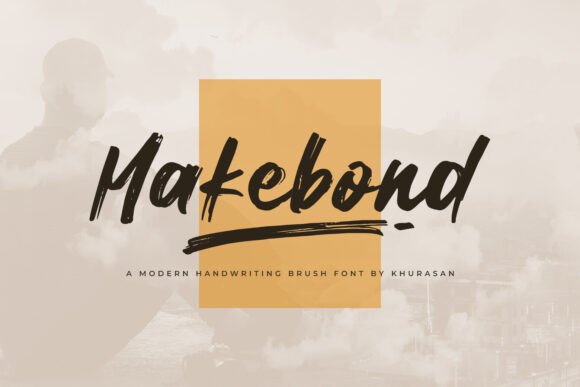
If you're designing candle labels, wedding welcome signs, boutique tags, or digital planner pages, you know how much a single font can shape your product’s personality—and your customer’s first impression. Makebond is that rare script font that feels both playful and polished: a modern brush typeface with natural stroke variation, subtle bounce, and just the right amount of whimsy. It’s not overly ornate, so it stays legible at small sizes—but it’s expressive enough to carry emotion in a single word like “Welcome,” “Hand-poured,” or “Blessed.” As a crafter who cuts vinyl daily and ships hundreds of printable downloads a month, I reach for Makebond when I need warmth without sacrificing clarity.
What makes Makebond especially practical for physical products is its balanced rhythm. Unlike some ultra-thin scripts that vanish on matte sticker paper or blur when printed at 8pt on tea towel tags, Makebond holds its shape. Its brush-inspired weight contrast—thicker downstrokes, lighter upstrokes—gives it presence even at 12–16pt on product labels or 24pt on farmhouse-style wooden signs. I’ve used it successfully on Cricut Explore Air 2 and Silhouette Cameo 4: the curves cut cleanly, no jagged edges, and the spacing between letters avoids accidental welds during vector conversion. For SVG creators, the clean outlines mean fewer anchor points to clean up before uploading to Etsy.
You’ll find Makebond shines brightest where personality meets purpose. Think: hand-stamped coffee bag tags for your small-batch roastery, foil-embossed greeting cards for birthdays and baby showers, or minimalist wedding stationery where “Mr. & Mrs.” needs elegance—not formality. It works beautifully on kraft paper, white linen cardstock, and even chalkboard-style digital mockups. I recently designed a set of printable Easter egg hunt clues using Makebond for the headers (“Follow the Carrot Trail!”) paired with a light sans serif for instructions—and customers specifically mentioned how “inviting” and “spring-ready” the typography felt.
For seasonal craft sellers, Makebond adapts effortlessly. Its quirky charm reads as joyful in holiday packaging (“Joyful & Jolly”), nostalgic in vintage-style lemonade stand signs, and refined in bridal shower invites. Because it’s a display font—not meant for long paragraphs—it excels in short, high-impact phrases: shop names on tote bags, flavor names on soap labels (“Lavender + Oat”), or titles on downloadable wall art prints. Just avoid body text or fine print; save that for a clean sans serif companion.
Which brings us to pairing. Makebond lives happily beside simple, neutral fonts—no competing drama needed. Try it with a friendly geometric sans like Montserrat Light for product descriptions, or a warm serif like Playfair Display for elegant contrast in wedding suites. As part of the Script Amp category, Makebond fits naturally alongside other expressive handwritten fonts—but stands out for its brush texture and consistent baseline, which helps maintain alignment across multi-line signs or layered SVG designs. If your version includes alternates or swashes (check your download!), use them sparingly—for initials in monogrammed mugs or flourishes on invitation envelopes—but keep standard characters for readability in functional contexts like ingredient lists or care instructions.
Practical note: Makebond comes in OTF and TTF formats, fully compatible with Canva, Adobe Creative Cloud, Cricut Design Space, and Silhouette Studio. It supports basic Latin characters and common punctuation—ideal for English-language craft businesses, though double-check multilingual needs if you serve bilingual markets. No OpenType features like contextual alternates are listed, so don’t expect automatic ligature swaps—but the included character set covers everything you’ll need for labels, tags, and social media graphics.
Readability matters most where your product meets the real world. On 1” round stickers? Yes—if you keep phrases to 2–3 words (“Small Batch,” “Made With Love”). On fabric-printed shirts? Use it for chest logos at 36–48pt for crispness. For mug wraps or vinyl decals, avoid tight kerning on curved surfaces—give letters breathing room, especially around rounded letters like “O” and “S.” And always preview your design at actual size on screen *and* print a test sheet before cutting 50 labels. A quick 100% zoom check catches spacing issues faster than any mockup.
Licensing is non-negotiable when you sell physical goods or digital downloads. Makebond is a commercial font—meaning you’re fully covered to use it in client work, print-on-demand products (like Redbubble or Printful), SVG files for cutting machines, and printable templates sold on Etsy or Gumroad. Just remember: you cannot resell the font file itself, embed it in apps, or redistribute it as part of a design bundle. But yes—you absolutely can stamp it on handmade soap, embroider it onto linen napkins, or feature it in your Canva-based invitation suite. That peace of mind lets you focus on what matters: creating beautiful, cohesive, customer-winning products.
Whether you're sketching ideas in a notebook or finalizing a Shopify product page, Makebond delivers that sweet spot between handmade authenticity and professional polish. It doesn’t shout—but it lingers. It’s not fussy—but it feels intentional. And in a market where buyers scroll past dozens of listings in seconds, that quiet confidence in your typography? That’s your secret brand builder.